“Of all the things to come off a volcano, I did not expect jam.”
Mt. Ijen
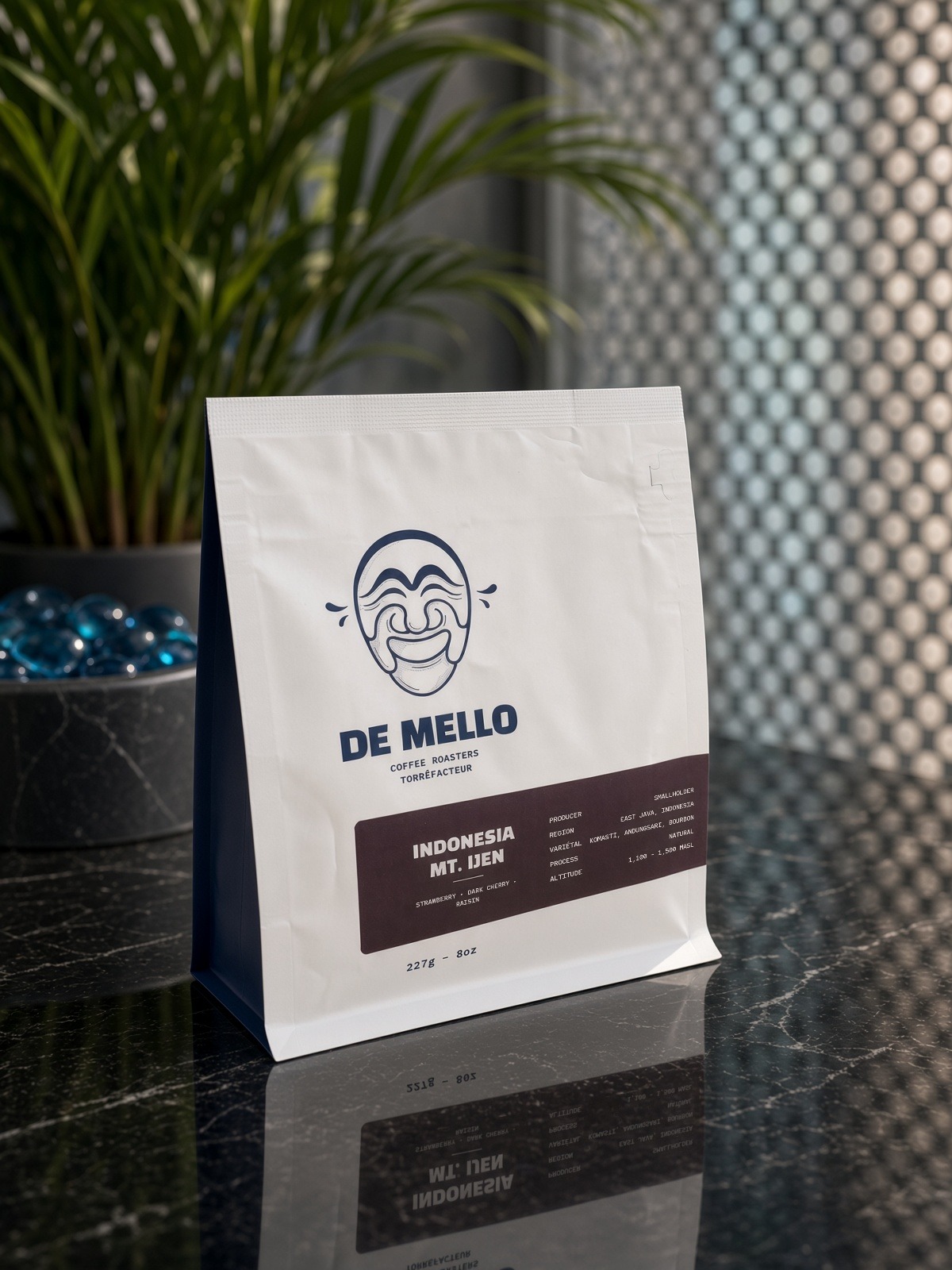
East Java, Indonesia · Natural · De Mello Coffee →
00read this with your agent
Ask your agent about this bag.
Copy one of these and paste it into whatever AI you use. It answers from this page and nothing else. An agent in a browser that supports WebMCP can read the page through its tools.
1Set up your AI optional, two minutes, once
2Then copy a prompt
Ijen burns blue at night. Its coffee tastes like jam.
Sweet and fruity, but not punch-in-the-face fruity.
Why this one
I knew Indonesia grows its coffee on volcanic soil, and I wanted to taste what that does to a cup. I picked a natural, and the volcano’s story sold it.
The bag
Sweet and fruity the moment the bag was cut, eight days off roast, but not punch-in-the-face fruity. It smelled like strawberry jam.
The sip
Not fresh strawberry. Jam. It is not sour and it does not punch: the acidity is only a hint, near the end.
And the jam is not only sweet. There is some of the cherry’s own fruit in it, a little bittersweet, though mostly sweet, and then a hint of citrus in the aftertaste. A good cup.
How it was made
A natural →: nothing is taken off, and the whole cherry dries with the seed still inside it. The smallholders who grow it pick the cherry by hand and sort it twice, for density and for colour, then dry it slowly, for 11 to 13 days, in the cool mountain air.
The place
Ijen is a cluster of volcanoes at the eastern tip of Java. Its crater holds Kawah Ijen, the largest highly acidic crater lake in the world, and at night sulfur gas from its vents burns with a blue flame. Below the crater lies the Ijen plateau: high, cool ground on volcanic soil. The Dutch planted coffee estates there in the late 1800s, and today smallholders farm the slopes around them. This lot grows at 1,100 to 1,500 m.

The verdict
8.5/10
“Sweet and round, like jam, with a bitter edge you only find if you look for it. I will buy it again when I want something sweet and easy.”
Character
- Acidity
- 3
- Sweetness
- 7
- Body
- 7
- Bitterness
- 4
- Fruity/
Floral - 7
- Nutty/
Cocoa - 2
- Roasted/
Earthy - 3
- Fermented
- 2
Intensity, not quality. A low number is a different coffee, not a worse one. Rated at eight days off roast, once the shot was where I wanted it.
Hover or tap an axis.
The processDe Mello’s account, step by step. Drawn in order and equal, not to scale.
Picked by hand
The ripe cherry is picked by hand by the smallholders who grow it.
Sorted twice
Once for density and once for colour, before anything dries.
The slow dry11–13 days
The whole cherry dries slowly in the cool mountain air, the seed still inside it.
Quick facts
- Origin
- Mt. Ijen, East Java, Indonesia
- Producer
- Smallholders
- Altitude
- 1,100–1,500 m
- Process
- Natural
- Variety
- Komasti, Andungsari, Bourbon, Kartika
- Roast
- Medium, three of five on De Mello’s scale
- Roaster’s notes
- Strawberry, dark cherry, raisin
- Roast date
- 28 Sep 2026
Ijen, and four varieties on one slope
Ijen is not one mountain but a cluster of volcanoes on the border of Bondowoso and Banyuwangi, at the eastern tip of Java, with Mt. Raung as its neighbour to the west. Arabica from the slopes of the two has carried one protected name since 2013, Java Ijen-Raung, the way Champagne names a region and not a brand. This lot grows at 1,100 to 1,500 m, high and cool enough that the cherry ripens slowly.
What makes this lot unusual is what grows side by side. The smallholders on these slopes grow Komasti, Andungsari, Bourbon and Kartika together, and the lot is all four. De Mello’s claim is that each brings its own character and the cup is layered because of it.